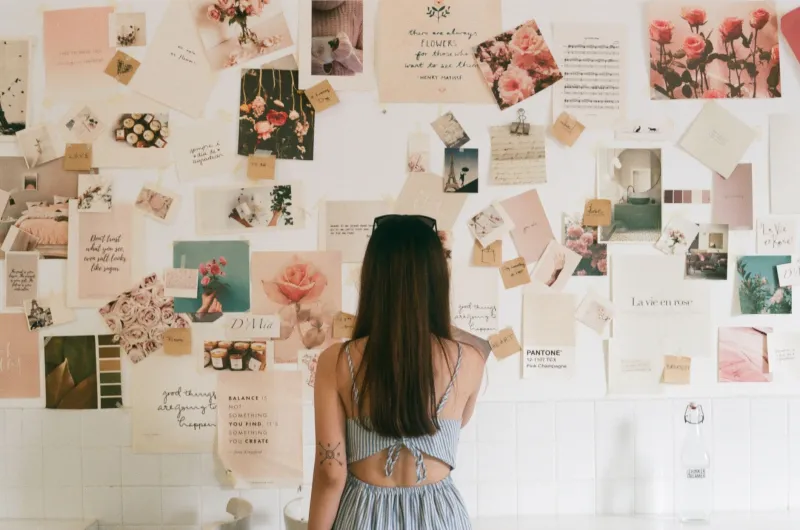
What You Watch, Read, and Listen to Is Quietly Building (or Breaking) Your Creative Voice
Everybody wants to talk about the work. The portfolio, the reel, the case study deck. And sure, those things matter. But there's a conversation that doesn't happen nearly enough in creative circles, and it's the one about what goes in before anything comes out.
What are you actually consuming? And more importantly — are you consuming it with any intention at all?
Because here's the thing: taste isn't some soft, aesthetic accessory you either have or you don't. It's infrastructure. It's the invisible scaffolding underneath every decision you make when you sit down to create something. And if you're not actively building it, sharpening it, and yes, defending it — you're leaving one of your most powerful creative tools completely unattended.
Your Inputs Are Your Fingerprint
Think about the creators whose work you can recognize immediately. The directors whose films feel unmistakably theirs. The designers whose layouts carry a specific gravity. The writers whose sentences have a rhythm you could pick out in a lineup. What do they all have in common?
They didn't arrive at that distinctiveness by accident. It was built over years of deliberate consumption — of knowing exactly what moved them, what bored them, what made them want to flip the script entirely.
Stan Lee once said he wrote the kind of comics he'd want to read. Ava DuVernay has spoken openly about the films that shaped her visual language. Rick Rubin is famously omnivorous in what he listens to, pulling from gospel, punk, and classical in the same breath. These aren't just fun facts about famous people. They're case studies in how taste becomes voice.
Your creative fingerprint isn't formed in the studio. It's formed in the thousands of hours before you ever get there.
The Difference Between Consuming and Absorbing
Here's where a lot of creators get it twisted. Consumption alone doesn't do the job. We're all drowning in content right now — more films, more music, more design work, more writing than any single person could process in a lifetime. Access has never been the problem.
The gap is in absorption. There's a real difference between watching something and actually sitting with it. Between listening to an album while you scroll and putting your phone down and listening. Between saving a design reference on Pinterest and actually interrogating why it works — what's doing the heavy lifting, what you'd push further, what you'd strip away.
Discernment is the muscle here. And like any muscle, it only develops if you actually use it.
Try this: the next time something creative genuinely stops you in your tracks — a campaign, a book cover, a song intro, a film scene — don't just move on. Slow down. Ask yourself what specifically triggered that reaction. Was it the pacing? The restraint? The unexpected color choice? The way the copy trusted the reader to keep up? That kind of active engagement is where your taste gets refined, one encounter at a time.
Curating Your Creative Diet
If taste is infrastructure, then what you choose to consume is essentially your building material. And just like with any build, quality matters more than quantity.
This doesn't mean being a snob. It doesn't mean only watching Criterion Collection films or exclusively reading literary fiction. It means being intentional about range. The best creative palettes aren't narrow — they're wide and weird and full of unexpected combinations. Jazz and brutalist architecture. True crime podcasts and mid-century typography. Anime and the Harlem Renaissance. The collisions between distant references are where the most original ideas live.
But range without depth is just trivia. You need both. Go wide enough to make unexpected connections, and go deep enough in certain areas to actually understand what's happening beneath the surface.
One practical move: create a running list of the work that genuinely affects you. Not just what's impressive or well-reviewed — what actually lands for you personally. That list is a map of your taste. Study it. Notice the patterns. Those patterns are telling you something about your creative identity that no brief or client feedback ever could.
The Taste Gap — and Why It Matters
Ira Glass famously described the gap between taste and ability — that painful early period where you know what good work looks like but can't quite make it yet. He was right that the gap exists. But what he was also describing, without quite naming it, is the importance of having developed taste in the first place.
You can't close a gap you can't see. And you can't see it if your taste isn't calibrated to something higher than what you're currently producing.
This is why creators who invest in their taste tend to improve faster. They have a clearer internal compass. They know when something they've made isn't quite there yet — not because someone told them, but because their eye is sharp enough to catch it. That self-correction loop, powered by genuine discernment, is one of the most valuable things you can develop.
It also protects you from a specific kind of creative stagnation: the trap of making work that looks current but feels empty. Trend-chasing is almost always a symptom of underdeveloped taste. When you don't have a strong internal reference system, the external one — whatever's performing well on social, whatever the algorithm rewards — fills the vacuum. And that's a slow creative death.
Protecting Your Palette
Here's a quieter point that doesn't get enough airtime: you have to protect your taste from dilution.
Constant exposure to mediocre work, especially at high volume, has a numbing effect. It gradually recalibrates your baseline downward. This is partly why doom-scrolling through generic content feels creatively draining in a way that's hard to name — it's not just wasted time, it's actively eroding your sense of what's possible.
Be selective about what you let into your creative environment. Not in a precious, gatekeeping way — but in the way you'd be selective about what you eat if you were training for something. You wouldn't fuel a serious effort with nothing but junk. The same logic applies here.
Seek out work that challenges your current thinking. Sit with things that make you uncomfortable or confused. Read writers who are better than you. Watch films that demand more from you as a viewer. Listen to music that doesn't immediately resolve into something easy. That friction is exactly where your taste grows.
Your Portfolio Is the Outcome. Your Taste Is the Origin.
At the end of the day, what you make is a reflection of what you've absorbed. The portfolio is the visible tip of a much larger iceberg — and the iceberg is everything you've ever consumed with genuine attention and curiosity.
The creators who build work that lasts, that feels specific and alive and impossible to replicate, aren't just technically skilled. They've done the deeper work of knowing what they love, understanding why they love it, and letting that knowledge quietly inform every choice they make.
So yeah — keep building the portfolio. But don't sleep on the invisible work. What you're feeding your creative mind right now is already shaping what you'll make next. Make sure it's worth eating.