Glitch in the Matrix: Why AI Will Never Out-Create You
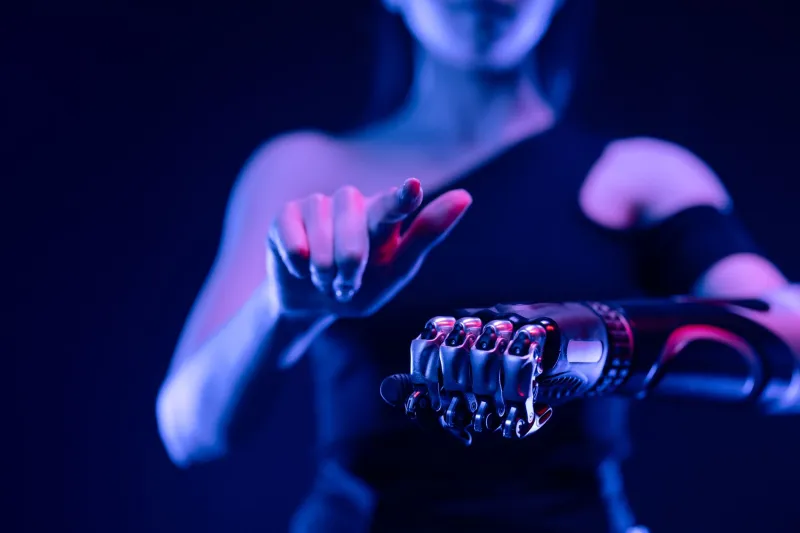
Let's be honest about what AI is genuinely good at. It's fast. It's tireless. It can synthesize patterns from more data than any human brain could process in a hundred lifetimes. Ask it for a logo concept, a product description, a social media calendar, a first draft — it'll deliver something usable in seconds. For a lot of tasks, that's legitimately useful.
But here's what's been bugging us at Kream, and probably bugging you too if you've spent any real time working alongside these tools: the output is competent in a way that starts to feel hollow after a while. Technically adequate. Statistically likely. Missing something that's hard to name but impossible to ignore.
That something is the whole ballgame. And it's yours.
What Algorithms Actually Do
To understand what AI can't create, you first have to understand what it's actually doing when it creates anything at all. Generative AI — whether it's producing text, images, music, or code — is fundamentally a prediction engine. It's been trained on massive datasets of human-made work, and it generates output by calculating what comes next based on patterns in that data. It is, at its core, a very sophisticated averaging machine.
This is why AI content often feels like it was written for everyone and therefore for no one. It's optimizing for statistical plausibility, not for truth. It doesn't have a point of view — it has a probability distribution. It doesn't believe anything. It hasn't lived through anything. It has never been embarrassed, heartbroken, blindsided, or blown away.
And that's not a bug that future model versions will patch. It's structural. The algorithm doesn't dream because dreaming requires a self — a specific, situated, experience-soaked consciousness that has something to say about what it means to be alive right now, in this body, in this culture, in this particular weird moment in American history.
The Mess Is the Message
Human creativity is irrational in ways that matter enormously. We make unexpected connections not because we've processed the most data, but because we've lived through things that leave marks. The grief that changes how you see color. The road trip that rewires your sense of scale. The conversation that happens at 2 a.m. and rearranges something fundamental.
These experiences don't just inform creative work — they are creative work, in the sense that they generate the specific, irreproducible perspective that makes one creator's output different from every other creator's output. That specificity is what audiences actually connect with. Not technical execution. Not formal correctness. The felt sense that there is a real person on the other side of this thing, and they're telling you something true about what it's like to be human.
AI can simulate that feeling, briefly and impressively. But simulation isn't the same as source. Readers, viewers, and listeners are getting better — not worse — at detecting the difference. The uncanny valley of content is real, and it's widening.
Your Irreproducible Variable
Here's the strategic reframe that matters most right now: in a landscape increasingly saturated with AI-generated content, authentic human perspective isn't just artistically valuable. It's economically scarce.
Scarcity creates value. That's econ 101. When everyone can generate a passable blog post or a functional brand identity in thirty seconds, the thing that commands attention and premium pricing is the thing that can't be generated — the specific, idiosyncratic, you-shaped take that comes from your particular combination of experience, obsession, and point of view.
The creators who are thriving in the AI era aren't the ones fighting the tools. They're the ones who've gotten radically clear on what only they can bring. They're using AI for the commodity work — the scaffolding, the first passes, the logistical heavy lifting — and reserving their own cognitive energy for the layer of thinking that no model can replicate.
That's not a defensive posture. That's leverage.
What Original Actually Looks Like Now
Original creative work in an AI-saturated landscape has some recognizable signatures. It takes positions. It has friction. It admits uncertainty and contradiction. It references specific, lived experience rather than generalized human experience. It sounds like someone — not like content.
It's also, increasingly, work that emerges from genuine creative process rather than prompt engineering. The difference between a creator who uses AI as a starting point and one who uses it as a replacement is the difference between a chef who uses a food processor and one who orders everything pre-made. Same kitchen, completely different relationship to craft.
The work that will matter in the next decade — the campaigns that land, the stories that circulate, the brands that build real loyalty — will be distinguished by the quality of human thinking behind them. Not despite AI, but in relief against it.
The Advantage Is Already Yours
You've been building your creative advantage your entire life without knowing that's what you were doing. Every weird phase you went through, every failure that taught you something, every obsession that seemed useless, every experience that changed how you see things — that's your training data. And it's a dataset of one.
No model has it. No model can have it. And as AI gets better at producing the average, the specific gets more valuable by the day.
The algorithm doesn't dream. But you do. That's not a small thing. Right now, in the creative economy, it might be the whole thing.