Your Best Tool Might Be Your Biggest Problem
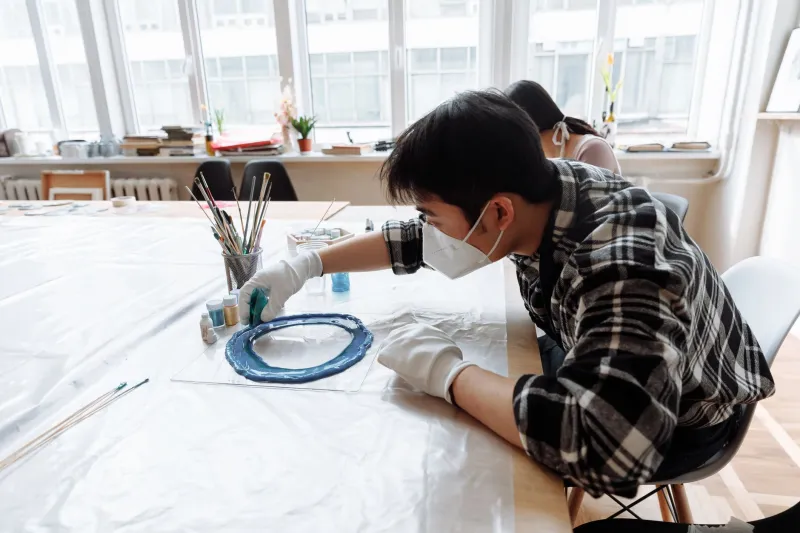
There's a specific kind of creative pride that comes from mastery. You've put in the hours. You know the shortcuts. You can feel when something's working before you can even articulate why. That fluency is real, and it's earned — but it has a shadow side that most creators don't want to talk about.
The better you get at your tools, the quieter your creative risk-taking becomes.
Not because you're lazy. Not because you've lost the hunger. But because your brain, bless it, is extremely efficient at routing you toward what already works. And "what already works" is the enemy of what could be extraordinary.
The Mastery Paradox
Here's the uncomfortable truth: expertise in a medium can function like a tax on imagination. When you know Photoshop cold, you stop seeing it as a space of possibility and start seeing it as a production environment. When you've been writing in the same format for three years, your brain starts auto-completing sentences before you've even thought them. The tool stops being a collaborator and starts being a conveyor belt.
Psychologists call this functional fixedness — the tendency to see objects and systems only in terms of their established use. It's been studied in the context of problem-solving for decades, but it maps almost perfectly onto creative stagnation. When you've spent 10,000 hours in a particular medium, you've also spent 10,000 hours reinforcing a very specific set of assumptions about what that medium is for and what you can do with it.
You're not stuck because you're bad at your craft. You're stuck because you're too good at it.
The Resistance Is the Signal
Ask any creator who's deliberately switched mediums — or picked up a tool they had no business using — and they'll describe a very specific feeling in the early days: pure, uncut discomfort. The graphic designer who picked up a film camera for the first time in years and hated how slow it was. The podcaster who tried writing long-form essays and felt like a kid learning to walk again. The animator who took a ceramics class and nearly quit after week two.
That discomfort? That's not failure. That's your nervous system registering genuine novelty.
When something feels awkward and resistant, it means you're operating outside your automated pathways. You're back in beginner's mind — the state where every decision requires actual thought, where you can't rely on muscle memory, where the unexpected becomes possible again. That's not a setback. That's the entire point.
There's a reason so many of the most creatively fertile periods in artists' careers happen when something external forces a change. Injury, budget cuts, a move to a new city, a broken piece of equipment. Constraint and unfamiliarity crack open creative thinking in ways that comfort simply cannot.
Case Studies in Productive Discomfort
Take the trajectory of someone like Jack White, who has openly talked about building intentional limitations into his creative process — using cheap, difficult instruments, recording under weird constraints, stripping away the tools that made things easy. The roughness wasn't aesthetic. It was strategic. The friction generated something that polish couldn't.
Or look at how the team behind some of the most visually inventive indie games of the last decade often started in mediums with zero overlap — painting, theater, architecture — before arriving at game design. The cross-contamination of sensibilities is what made the work feel different. They didn't know the "right" way to do things, so they invented their own.
In the design world, this shows up constantly. The best brand identities often come from designers who came up through unexpected disciplines — fashion, environmental design, industrial product work — and brought a completely different vocabulary to visual communication. The unfamiliarity was the feature, not the bug.
How to Engineer Your Own Discomfort
You don't need to blow up your whole creative practice. You don't have to throw out the tools that pay your bills or abandon the skills that define your professional identity. But you do need to create deliberate pockets of productive strangeness in your creative life.
A few approaches that actually work:
Set a medium constraint for a fixed period. One month, one tool you don't know well. Don't try to master it. Just use it. The goal isn't competence — it's exposure to a different logic.
Collaborate with someone whose medium is nothing like yours. A writer working with a sound designer. A photographer working with a UX researcher. The conversation itself will rewire how you think about your own work.
Consume work from fields you know nothing about. Not to mine it for ideas — just to let it land without the filter of expertise. Watch competitive figure skating. Read architecture criticism. Listen to field recordings. Let your brain encounter forms of excellence it has no framework for.
Deliberately make something bad. Pick a medium where you're a complete beginner and make something with zero pressure to be good. The point is to remember what it feels like to not know what you're doing — and to survive it.
The Real Cost of Staying Comfortable
Creative comfort isn't neutral. It compounds. Every year you spend only in your strongest medium is a year your range narrows a little more, your assumptions calcify a little harder, and your work drifts a little closer to what you've already made before.
The creators who keep surprising people — who have long careers that evolve rather than plateau — are almost never the ones who doubled down on what they were already great at. They're the ones who kept introducing productive chaos into their process. Who kept finding new ways to be bad at something before they figured out how to be good at it.
Mastery is worth pursuing. But mastery in service of the same thing, forever, is just a very sophisticated form of standing still.
The cream rises to the top — but first it has to move. So does your creative practice.
Pick up something unfamiliar. Feel the friction. Stay with it long enough to find out what's on the other side.


